- Superintelligence
- Posts
- US's AI Strategy to Lead Globally
US's AI Strategy to Lead Globally
Hey friends! Welcome to the development of the AI world. Today's top AI news highlights US aims for global ai leadership, two firms watermark AI-generated text, and AI fuels US market dominance. Additionally, meet UCLA's SLIViT AI revolutionizes 3D medical imaging. Let’s dive in—enjoy this AI ride in just 3 minutes!
The AI World Today
US Aims for AI Leadership
Firms Watermark AI-Generated Text
AI Fuels US Market Dominance
+
Heads Up
AI Solution
US Releases AI Strategy to Lead Globally

Illustration: Superintelligence AI
President Joe Biden’s administration unveiled a new AI-focused National Security Memorandum, aiming to secure the US as a leader in “safe, secure, and trustworthy” AI amid rising global competition. The directive urges federal agencies to bolster semiconductor supply chains, integrate AI in government technology, and enhance intelligence on foreign AI threats. It mandates safeguards to address AI-related privacy, discrimination, and human rights risks, reinforcing AI's alignment with democratic values. The memorandum also highlights collaboration with allies to ensure AI's adherence to international law. As the US anticipates intensified AI-driven military and intelligence competition, it will host a global safety summit in San Francisco next month to discuss AI regulation and cooperation.
DeepMind and Hugging Face Secure AI Content

Image: Google Deepmind
Google DeepMind and Hugging Face have launched SynthID Text, a watermarking tool for marking and detecting text generated by specific large language models (LLMs) without compromising text quality. SynthID Text, now part of Hugging Face's Transformers library, employs a "Tournament sampling" algorithm to insert an invisible watermark detectable by a classifier. This method adjusts the text's token generation, creating a unique statistical signature. SynthID’s watermark is resilient to minor edits and paraphrasing, though it struggles with heavily modified text. The tool aims to curb misinformation, moderate content, and manage AI-generated text. In a test with Gemini models, SynthID effectively maintained response quality while being identifiable, demonstrating scalability for large-scale AI applications.
JPMorgan: AI to Sustain US Market Dominance
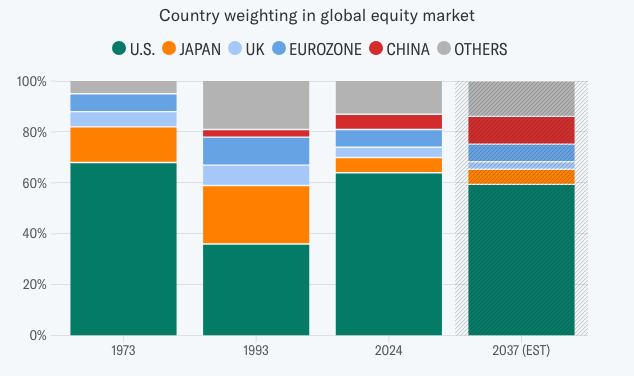
Screenshot: JPMorgan Asset Management
A JPMorgan Asset Management report projects the US will maintain its global stock market dominance, driven largely by artificial intelligence (AI) advancements. Currently holding 64% of global market share, the US share may dip to 60% by 2037, but AI will continue boosting US companies across sectors, not just Big Tech. According to JPM’s Monica Issar, increased AI investments in areas like energy and utilities will enhance revenue and profit margins. Nvidia's market cap, surpassing most G7 nations, exemplifies US dominance. DataTrek Research's Nicholas Colas suggests AI’s integration will help the S&P 500 achieve over 10% annual returns, with US companies leading global AI adoption and venture capital investment, leaving non-US competitors unlikely to surpass them.
Heads Up
Elon Musk’s xAI has enhanced its Grok AI model with image-understanding, allowing paid X users to upload images and ask the chatbot questions about them.
AI startup Genmo has launched Mochi 1, an open-source video generation model, aiming to rival closed competitors like Runway and Pika while remaining free for developers.
Runway's Act-One AI creates expressive character animations from a single video or image, transferring facial performances to characters without motion capture, preserving subtle expressions.
Google is reportedly developing AI technology capable of autonomously navigating a web browser to complete tasks like online research and shopping.
Meta announced its AI chatbot will utilize Reuters content to provide real-time answers on news and current events, marking a new collaboration with a publisher.
AI Solution
UCLA's SLIViT AI Revolutionizes 3D Medical Imaging
UCLA researchers have developed SLIViT, an AI model that quickly and accurately analyzes 3D medical images across multiple imaging modalities, including MRIs, CTs, retinal scans, and ultrasounds. SLIViT, led by computational medicine expert Dr. Eran Halperin, uses deep learning with a unique pre-training and fine-tuning process on 2D datasets, allowing it to identify disease biomarkers in 3D scans despite limited 3D data availability. The model's adaptability enables rapid, expert-level analysis in places lacking medical imaging specialists, improving patient care accessibility. Additionally, SLIViT demonstrated strong transfer learning, where fine-tuning on distinct image types, like retinal and liver scans, improved its accuracy. Researchers used NVIDIA GPUs to test SLIViT’s scalability, aiming to provide low-cost, high-quality medical imaging analysis globally.