- Superintelligence
- Posts
- TTT Architecture
TTT Architecture
Hi Friends, Welcome back! In today’s edition of Superintelligence AI, you will meet a new privacy-focused AI email assistant, new AI architecture, US-French NeMo Model and Chinese giant's latest audio-centered AI model. Many more included! Enjoy the first global AI newsletter.
The AI World Today
NVIDIA-Mistral's NeMO Model
Alibaba’s Advanced Qwen2-Audio
Meet New Coalition for AI Security
TTT Architecture Vs Transformers
New AI Email Assistant Launched
Australian Lawyers Embrace AI
+
Heads Up
Save the Date
AI Solutions
Mistral NeMo: Powerful, Efficient Small Langauge AI Model
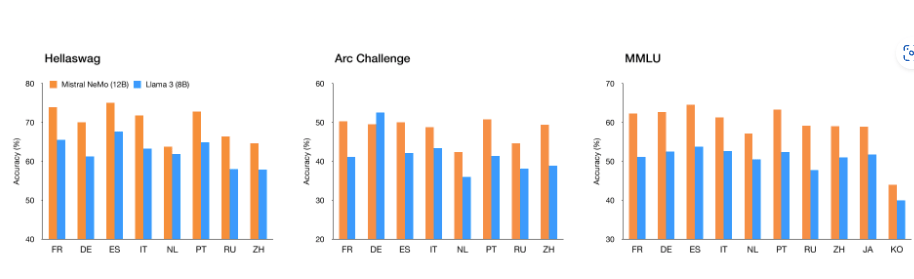
Screenshot: Mistral NeMo
Mistral AI and NVIDIA have launched Mistral NeMo, a groundbreaking 12B model with a context window of up to 128k tokens. This advanced AI model excels in reasoning, world knowledge, and coding accuracy, offering a significant technological leap. Easy to integrate as a drop-in replacement for Mistral 7B, Mistral NeMo supports efficient FP8 inference with quantization-aware training. The new Tekken tokenizer, trained on over 100 languages, makes it highly efficient for multilingual applications. Available on HuggingFace and as an NVIDIA NIM inference microservice, Mistral NeMo is designed to run on standard business hardware like a single NVIDIA L40S, GeForce RTX 4090, or RTX 4500 GPU. This model reflects the trend towards smaller language models that maintain power and speed, marking a shift in AI development without sacrificing performance. Mistral continues to demonstrate its open-source capabilities, competing with industry giants.
Chinese Giant Alibaba Unveils Advanced Qwen2-Audio Model

Screenshot: Huggingface
On July 17, Alibaba Group unveiled Qwen2-Audio, a cutting-edge large-scale audio-language model. This model accepts various audio inputs, performing sophisticated audio analysis and generating textual responses to speech instructions. Qwen2-Audio stands out by simplifying the pre-training process using natural language prompts and expanding data volume. This enhances its instruction-following capabilities and introduces two distinct modes: voice chat and audio analysis. Unlike previous models, Qwen2-Audio intelligently switches modes without system prompts, understanding complex audio content, including multi-speaker conversations and simultaneous sounds. DPO optimization improves its factual accuracy and adherence to desired behavior. Evaluation on AIR-Bench shows Qwen2-Audio surpasses previous state-of-the-art models like Gemini-1.5-pro in audio-centric tasks.
AI-Powered Microsoft Designer App Goes Live

Screenshot: Huggingface
On July 5, researchers from Stanford, UC San Diego, UC Berkeley, and Meta unveiled Test-Time Training (TTT), a promising new architecture. Unlike transformers, TTT models replace the hidden state with a machine learning model, efficiently encoding data into weights. This approach allows TTT models to process significantly more data without increased computational demands. While transformers rely on a growing hidden state, TTT models maintain a constant internal size, enhancing performance. However, skepticism remains as TTT isn't a direct replacement for transformers and has only been tested on small models. Despite this, the future looks bright, with potential to handle vast amounts of diverse data far beyond current capabilities.
US Industry Leaders Form Coalition for AI Security

Image: Google
On July 18, at the Aspen Security Forum, industry leaders announced the Coalition for Secure AI (CoSAI) to advance AI security, leveraging Google's Secure AI Framework (SAIF).Founding members include Amazon, Anthropic, Chainguard, Cisco, Cohere, GenLab, IBM, Intel, Microsoft, NVIDIA, OpenAI, PayPal, and Wiz, housed under OASIS Open. CoSAI's inaugural workstreams will focus on software supply chain security for AI systems, preparing defenders for a changing cybersecurity landscape, and developing AI security governance as AI evolves, CoSAI aims to ensure robust risk management and responsible implementation.
Proton Introduces Privacy-Focused AI Email Assistant

Image: Proton
Swiss-based privacy app maker Proton has introduced Proton Scribe, a privacy-first AI writing assistant for email, launched on July 18. Built on the Mistral 7B model, Proton Scribe helps users compose, redraft, and proofread emails with simple prompts while ensuring data privacy by running entirely on-device. Unlike other AI tools, Proton Scribe doesn’t learn from user data, addressing significant privacy concerns, especially for businesses. It can also be configured to run on Proton's servers for faster performance. Initially available for Proton Mail on the web and desktop, the assistant costs $2.99 per month for business plans, with potential future expansion to mobile devices and other Proton products.
Australian Lawyers Approve AI for Administration

Image: Livemint
A Thomson Reuters study reveals that 99% of Australian legal professionals find AI use in administrative tasks ethical. Additionally, 83% are comfortable using AI for research and analysis. The Future of Professionals report highlights AI's potential to save significant time, potentially translating to US$100,000 in additional billable hours for lawyers. Currently, 63% of respondents have integrated AI into research, summarisation, and drafting tasks, with half of law firms prioritising AI in their strategies for the next 18 months. However, nearly two-thirds of professionals emphasize the need for human oversight, and 95% oppose AI making court decisions or handling complex legal matters. The study surveyed over 2,200 professionals from various regions in April to May.
Heads Up
AI Model: Groq Introduces Llama-3-Groq-Tool-Use Models
AI Innovation :Google Brings AI to US Broadcast of Paris Olympics
AI Partnership: OpenAI Holds Talks with Broadcom About Developing New AI Chip
AI Innovation:HP’s New AI Computer Raises the Stakes in the Battle of Tech Hardware
AI Infrastructure: Iceτi AI Expands to U.S. to Boost AI Infrastructure with American Partners
AI Workforce: Alibaba Sees AI Talent Depart to Start Own Business amid China’s Unicorn Boom
AI Service: Samsung Personalizes AI for Chinese Consumer Base
AI India: Tredence Expands Operations with New AI Centers in India
AI Law: Maharashtra Unveils India's First AI Crime-Fighting Initiative
In Funding: Wise AI Raises $10M to Address KYC Gap in Southeast Asia
AI Data: Warburg-Backed PDG Eyes Asia Data Center Expansion Fueled by AI
AI Partnership: Pearl and Patterson Dental Canada Join Forces to Advance Dental AI
AI Deal: Shipping Giant CMA CGM Signs AI Deal with Google
AI Music: Spotify Launches a New Voice and Language for its AI DJ
AI Feature: Google Tests AI Overviews In Workspace Accounts In The UK
Save the Date
September 25 - 26: Don’t Miss Meta Connect 2024
AI Solutions
AI Symptom Checker for Kidney Disease Detection

Screenshot: Ubie/YouTube
Global healthcare AI platform Ubie and the American Kidney Fund (AKF) are collaborating to refine Ubie's AI symptom checker for kidney disease detection, aiming to accelerate patient treatment. Global healthcare AI platform Ubie and the American Kidney Fund (AKF) are collaborating to refine Ubie's AI symptom checker for kidney disease detection, aiming to accelerate patient treatment. Ubie's AI, trained on clinical research and reviewed by physicians, can predict 1,100 diseases. Deployed in 1,700 Japanese clinics, the AI benefits from physician feedback. AKF will provide 25-30 diagnosed patients to help fine-tune Ubie's algorithm. This partnership will enhance the accuracy of symptom checks by incorporating patient input, ensuring questions are user-friendly and effective. By improving early detection and care guidance, Ubie aims to shorten diagnosis times, directing patients to AKF for further information and support, thereby speeding up their care journey.