- Superintelligence
- Posts
- Superintelligence Europe — Special Report: Unlocking Europe's AI Potential 2026
Superintelligence Europe — Special Report: Unlocking Europe's AI Potential 2026
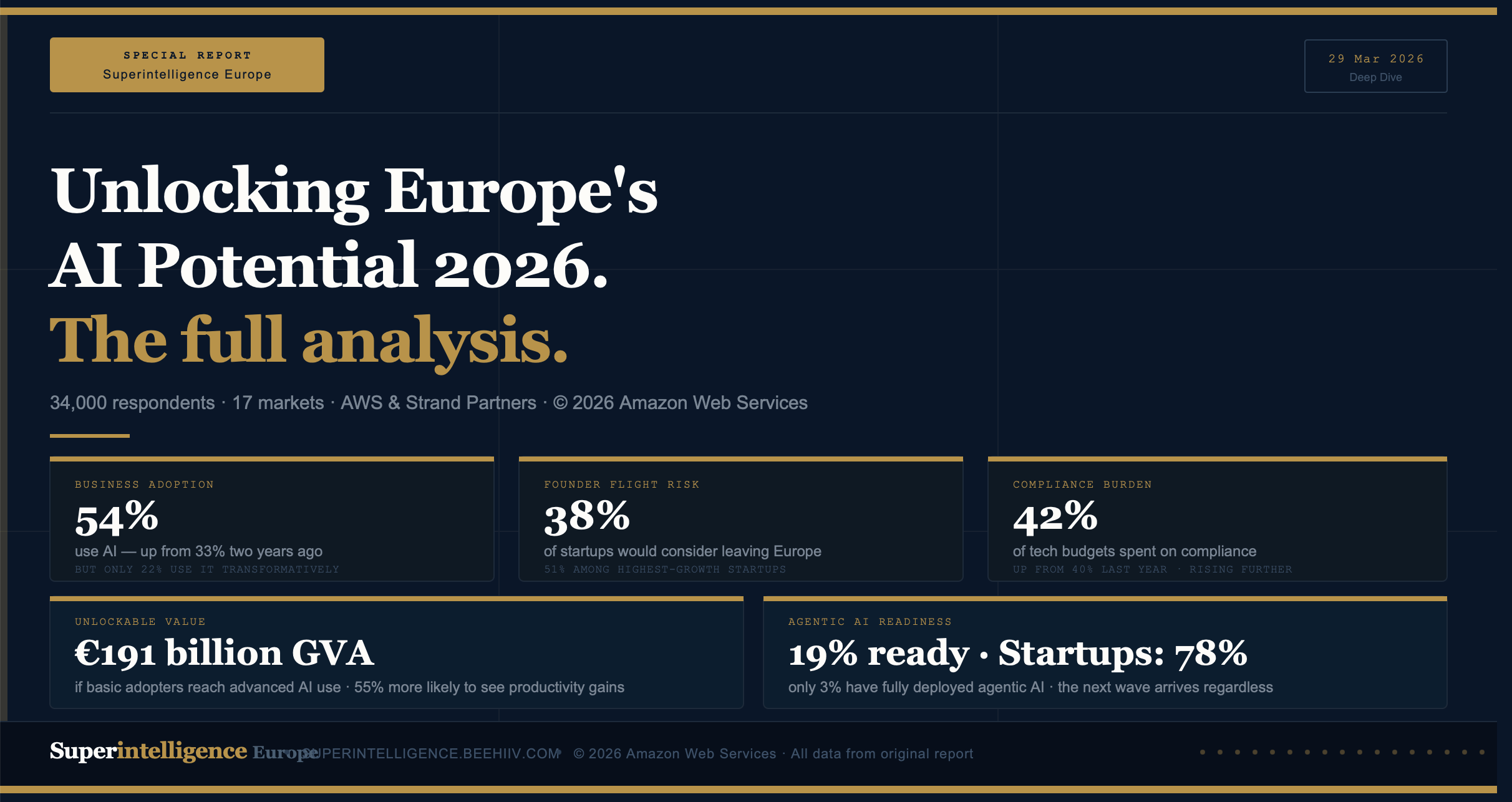
54% of European businesses use AI. Only 22% do anything transformative with it. 38% of startups would consider leaving. The most important report on European AI this year — fully analysed.
In partnership with

Full report analysis · Unlocking Europe’s AI Potential 2026 · Sunday, 29 March 2026 | ||||||||||||||||||||||||||||
| ||||||||||||||||||||||||||||
Special Report — Sunday, 29 March 2026 The numbers from this report have appeared across our briefings this week. Now we read the whole thing. AWS and Strand Partners surveyed 34,000 respondents across 17 European markets — 17,000 citizens and 17,000 business leaders — to produce the fourth edition of what is now the most comprehensive annual measure of European AI adoption. The findings are simultaneously encouraging and alarming. More than half of European businesses now use AI. But only 22 percent are doing anything transformative with it. Thirty-eight percent of startups would consider leaving. And companies spend 42 pence in every tech pound on compliance. This is the report that defines the terms of Europe’s AI debate in 2026. Here is what it actually says — and what it means. Full report: Unlocking Europe’s AI Potential 2026 · Published by AWS & Strand Partners · © 2026 Amazon Web Services, Inc. All rights reserved. All data, findings, and quotations cited in this analysis are drawn directly from the report. This briefing constitutes independent editorial commentary and does not reproduce the full report. We encourage readers to read the original in full. | ||||||||||||||||||||||||||||
Finding 01 · Adoption & The Two-Tier Economy More than half of European businesses use AI. But most are using it wrong. European business AI adoption has reached 54 percent in 2026 — up from 42 percent in 2025 and 33 percent in 2024. That is a 29 percent year-on-year growth rate, and it means that for the first time, more European businesses use AI than do not. The headline is real. But the report immediately qualifies it with three stages of adoption maturity, and the qualification is devastating.
The most important number in the report is not 54 percent. It is the gap between 54 and 22. More than half of European businesses have adopted AI — but only 22 percent of those adopters are using it for anything that could be described as transformative. That figure barely moved from 2025 (21 percent). A year of accelerating adoption produced almost no acceleration in advanced use. The two-tier AI economy the 2025 report warned about is now entrenching itself. The disparity by business size is stark. Among startups, 76 percent have adopted AI and a much higher proportion are advanced users. Among large enterprises, adoption is 53 percent — but 62 percent of those enterprises are still at the most basic stage. Among SMEs (which constitute 99 percent of all EU businesses), adoption is 54 percent, but 59 percent remain basic. The €191 Billion Number The report calculates that helping Europe’s basic adopters reach advanced use would unlock €191 billion in gross value added. Companies at the basic stage report 40 percent productivity gains. Companies at the advanced stage report 62 percent. The gap between those two numbers — compounding across millions of European businesses — is the cost of staying stuck at basic use. | ||||||||||||||||||||||||||||
Finding 02 · The Next Wave Agentic AI is coming. Only 19% of European businesses feel ready for it. Startups: 78%. The report introduces agentic AI — systems capable of autonomously planning, executing, and optimising complex workflows — as the next wave that will compress the already-widening gap between advanced and basic adopters. The awareness and readiness numbers are sobering: only 24 percent of businesses have even heard of agentic AI. Of those familiar with it, just 3 percent have fully deployed it, while 10 percent are experimenting. When the concept was explained to those unfamiliar, 59 percent said they would consider adopting it — suggesting that the awareness gap, not the interest gap, is the primary barrier. Readiness follows the same two-tier pattern. Only 19 percent of businesses overall feel fully or very ready to adopt next-generation AI technologies including agentic AI. Among startups, that figure is 78 percent. A third of businesses say they are only slightly or not at all ready. The consequences are already measurable: businesses citing skills shortages are 39 percent less likely to be ready for next-generation AI; those citing legal uncertainty are 48 percent less likely. Early Agentic Adopters Are Already Seeing Results Among the small group that has deployed agentic AI, the benefits are already visible: 42 percent report faster decision-making and execution, 32 percent report increased operational efficiency, and 22 percent report improved scalability. As the technology matures, these advantages will compound. The organisations that have not started will find the gap increasingly difficult to close. | ||||||||||||||||||||||||||||
Finding 03 · The Three Structural Barriers 01 · Regulatory Fragmentation 42% of tech budgets spent on compliance — up from 40% last year. 81% say compliance costs have risen over three years. 80% expect further rises. The IMF estimates cross-border friction inside the EU is equivalent to a 110% tariff on services. Entering a new EU member state is effectively the same experience as entering a non-EU market. 02 · The Skills Gap 51% of businesses say skills shortages are preventing AI adoption or expansion. 75% say their AI skillset requires improvement. Average time to hire someone with the right digital skills: 6.8 months. Businesses citing skills shortages are 35% less likely to be advanced AI adopters. 03 · Funding Constraints 43% of businesses have no dedicated AI budget. 28% cite insufficient internal financial resources as a barrier. 25% say unclear ROI delays investment. 56% say government support is crucial to their AI investment decisions. 34% cite slow public procurement as a scaling barrier. | ||||||||||||||||||||||||||||
Finding 04 · The Startup Crisis 38% of European startups would consider leaving. Among the highest-growth startups, it rises to 51%. The most politically charged finding in the report is the one about founder flight. Over a third of European startups — the companies driving the continent’s AI frontier — say they would consider relocating outside Europe to scale their business. Among the highest-growth startups, that figure reaches 51 percent. These are not marginal companies. These are Europe’s most advanced AI adopters, its most innovative products, and its most competitive international players. Their reasons are practical, not ideological. Among those considering leaving: 56 percent cite greater availability of funding elsewhere, 50 percent cite faster ability to scale internationally, 46 percent cite better access to global markets, 45 percent cite lower operational costs, and 40 percent cite more favourable or predictable regulation. When asked what would convince them to stay, 65 percent said clearer, more proportionate, and stable regulation that supports innovation. More than half cited greater availability of both VC and public funding. What Europe Loses When a Startup Leaves When a startup relocates, Europe doesn’t just lose a company — it loses the jobs, the investments, the tax revenue, the supply chains, and the innovation spillovers that come with building a global champion. Perhaps most crucially, it loses the next generation of European AI leaders. — Unlocking Europe’s AI Potential 2026, p.23 The Compounding Risk The skills gap and the startup flight risk are not independent problems. When innovative companies leave, they take their best talent with them — making the skills gap worse for the companies that remain. The report explicitly frames this as a compounding spiral: founder flight worsens skills shortages, which worsen adoption rates, which reduce competitiveness, which drives more founders to leave. | ||||||||||||||||||||||||||||
Finding 05 · Citizens & AI 80% of European citizens now know what AI is. They want it in their hospitals and schools — not their data centres. The report’s citizen data provides a rarely-heard counterpoint to the infrastructure and investment debate. Daily AI use among citizens has risen from 20 percent in 2024 to 36 percent in 2026. Eighty percent say they are familiar with AI. Forty percent have used an AI chatbot in the past six months. Citizens are not waiting for the policy debate to conclude — they are already integrating AI into their daily lives faster than most businesses or public institutions are adapting. But citizens’ priorities for public AI spending are strikingly at odds with the infrastructure investment narrative that dominates Brussels. Healthcare tops the list at 72 percent. Defence and security follow at 58 percent. Energy and the green transition at 55 percent. Skills and education at 51 percent. AI-specific infrastructure scores just 8 percent. Europe-based cloud infrastructure: 6 percent. Citizens want better outcomes in the services that matter to their daily lives — not investment in the technology for its own sake. The Policy Implication The gap between what citizens prioritise (healthcare, security, education) and what the AI sovereignty debate focuses on (compute, cloud, data centres) is the most politically underappreciated finding in this report. Citizens are not sceptical of AI — 80 percent know what it is, and 36 percent use it daily. They are sceptical of AI investment that does not connect to outcomes they can feel. That is a messaging problem as much as a policy one. | ||||||||||||||||||||||||||||
The Report’s Three Recommendations What the report says Europe must do — and our read on each Recommendation 01 Make the public sector Europe’s flagship AI adopter The report argues that systematic public sector AI deployment — in healthcare, public services, and procurement — is the single most powerful accelerant available to European governments. 68 percent of businesses say they are most likely to increase AI adoption when the public sector leads. The report estimates streamlined public procurement could unlock €117 billion GVA and 1.8 million SME jobs. Our read: This recommendation is correct and underimplemented. The citizen data confirms public appetite. The procurement data confirms the barrier. The gap is political will and institutional capacity — not the policy argument. Recommendation 02 Incentivise AI investment and simplify regulatory scaling Standardise investment frameworks across member states, create frictionless growth capital pathways, reward companies scaling globally from a European base, and cut compliance duplication. The report frames cross-border regulatory friction as a 110 percent effective tariff — a figure that puts EU internal fragmentation in the same category as protectionist trade policy. Our read: The tension here is real. The Digital Omnibus voted through this week is a step in this direction — but it delays obligations rather than simplifies them. The report is asking for something structurally deeper than the current political agenda offers. Recommendation 03 Build AI readiness through skills, strategy, and responsible governance Embed AI literacy in education, build SME capability programmes, accelerate workforce development through public-private partnerships, and ensure responsible AI frameworks are treated as prerequisites for deployment — not afterthoughts. Only 24 percent of businesses have a responsible AI framework in place. Only 31 percent have a comprehensive AI strategy. Our read: The most neglected of the three. Skills investment has the longest lead time and the clearest compounding returns. It is also the recommendation least served by the current legislative agenda, which focuses almost entirely on rules rather than capabilities. | ||||||||||||||||||||||||||||
Editorial · Our Take on the Report The most important report on European AI this year. And three things it does not say. This is the most comprehensive empirical picture of European AI in 2026. The 34,000-respondent sample across 17 markets is larger than any comparable study. The longitudinal tracking across four editions gives the trend lines genuine credibility. The key findings — the adoption/advanced use gap, the founder flight risk, the compliance burden, the skills deficit — are all directionally consistent with what we observe across our daily coverage. The €191 billion GVA figure is the clearest expression yet of what is at stake. Three things worth noting that the report does not say directly. First, it is commissioned by AWS — a company with a clear commercial interest in European cloud adoption and regulatory openness. The findings are consistent with independent research, but the framing (choice, openness, flexibility) reflects the funder’s worldview. Read the recommendations with that in mind. Second, the 54 percent adoption figure includes businesses using AI in any form, including email filters and spell-checkers. The meaningful number is 22 percent advanced use — and even that threshold is set relatively low. Third, the founder flight data is self-reported intention, not actual relocation. The gap between “would consider” and “will move” is significant — though the direction of the signal remains real and concerning. None of these caveats change the core conclusion. Europe is advancing on AI adoption. It is not advancing fast enough on AI transformation. The gap between those two things is the defining policy challenge of 2026 — and this report is the clearest map of it available. | ||||||||||||||||||||||||||||
Data · Three-Year Trend Snapshot
Source: Unlocking Europe’s AI Potential 2026, AWS & Strand Partners. Survey of 34,000 respondents across 17 European markets. © 2026 Amazon Web Services, Inc. All rights reserved. |
88% resolved. 22% stayed loyal. What went wrong?

That's the AI paradox hiding in your CX stack. Tickets close. Customers leave. And most teams don't see it coming because they're measuring the wrong things.
Efficiency metrics look great on paper. Handle time down. Containment rate up. But customer loyalty? That's a different story — and it's one your current dashboards probably aren't telling you.
Gladly's 2026 Customer Expectations Report surveyed thousands of real consumers to find out exactly where AI-powered service breaks trust, and what separates the platforms that drive retention from the ones that quietly erode it.
If you're architecting the CX stack, this is the data you need to build it right. Not just fast. Not just cheap. Built to last.