- Superintelligence
- Posts
- Superintelligence Europe — No. 021
Superintelligence Europe — No. 021
Only 1 of 27 EU states in dialogue. BoE briefing imminent. ECB gathering data from the sidelines.
In partnership with

Everything that moved in European AI on Thursday 16 April · EU · United Kingdom · Romania · 11 days to Omnibus | ||||
| ||||
Issue No. 021 — Friday, 17 April 2026 Four stories today, each arriving from a different direction — and each, looked at closely, describing the same underlying condition. Europe is watching the most consequential AI systems take shape from outside the room. The Mythos story is the clearest illustration. A model capable of autonomously exploiting zero-day vulnerabilities has prompted emergency sessions at the US Treasury, the Federal Reserve, the Bank of Canada, and now the Bank of England. Of the EU’s 27 member states, only Germany has opened a dialogue with Anthropic — and none have been given access to the model. The UK, as so often on AI, moves on a different timeline. The Commission’s DMA action against Google, Romania’s gigafactory tender, and the Savills labour data are each Europe asserting capacity — to regulate, to build, to understand. The question this issue keeps circling: whether assertion is enough. Your briefing is here. | ||||
| ||||
Lead · EU-wide · UK · Frontier AI · Cybersecurity 01Anthropic’s Mythos Preview has set off emergency regulatory responses across three continents. Europe has been almost entirely frozen out. Only Germany — one of 27 EU member states — has opened a dialogue. None have access. Announced on April 7 and withheld from public release due to its ability to autonomously identify and exploit zero-day vulnerabilities, Anthropic’s Claude Mythos Preview has in the past week prompted urgent sessions at the US Treasury, the Federal Reserve, and the Bank of Canada. On Wednesday, Bank of England Governor Andrew Bailey named the model explicitly in a speech at Columbia University, describing cyber risk as the category climbing regulators’ rankings faster than any other. The BoE’s Cross Market Operational Resilience Group will convene within days to brief major UK banks, insurers, and exchanges. Bloomberg confirmed on Wednesday that Anthropic plans to release Mythos to UK financial institutions next week under Project Glasswing — a controlled rollout to 12 partners for defensive security work, including Amazon, Apple, and JP Morgan Chase. UK AI Security Institute · Evaluation Report · 13 April 2026 “Mythos Preview represents a step up over previous frontier models — in controlled conditions it executed multi-stage attacks on vulnerable networks and discovered and exploited vulnerabilities autonomously, tasks that would take human professionals days of work.” Across the EU the picture is starkly different. The ECB is gathering information via existing supervisory channels; no ad hoc senior-level meeting has been scheduled. Only Germany has initiated a dialogue — without yet gaining access. The structural gap — the UK’s AISI holding an evaluation report while Brussels operates on second-hand information — is a direct consequence of Project Glasswing’s US-first access architecture. | ||||
Brussels · Digital Markets Act · Platform Competition · AI 02The European Commission sent preliminary findings to Google on Thursday under the DMA, proposing it must share search data with rival engines — and explicitly with AI chatbots. Binding decision due 27 July. Google called it “overreach” and vowed to vigorously defend against it. Under Article 6(11) of the Digital Markets Act, the Commission is proposing that Alphabet must grant third-party search engines — and, for the first time explicitly, AI chatbots with search functionality — access to ranking, query, click, and view data on fair, reasonable, and non-discriminatory terms. EVP Teresa Ribera: “Data is a key input for online search and for developing new services, including AI. Access to this data should not be restricted in ways that could harm competition.” The proceedings — opened in January 2026 — are a specification mechanism, not a finding of non-compliance. A public consultation runs until 1 May. The Commission must issue a binding final decision by 27 July 2026. If Google fails to satisfy that decision, fines of up to 10% of Alphabet’s global annual turnover are available — a figure that could exceed $35 billion. For European AI challengers the implications are structural. Access to Google-scale query data has been one of the most durable competitive barriers facing search-adjacent AI products built on this side of the Atlantic. The explicit inclusion of AI chatbots as data beneficiaries is the Commission’s clearest signal yet that it regards conversational AI and traditional search as the same competitive arena. | ||||
Romania · Sovereign AI · Infrastructure · InvestAI 03Romania has formally launched its search for a consortium leader to build the Black Sea AI Gigafactory — a €5 billion, 100,000-accelerator project anchored at the Cernavădă nuclear plant. Expression of interest deadline: 14 June 2026. Romania’s Ministries of Energy and Finance, with technical support from the Romanian Digitalisation Authority, published a formal Expression of Interest on April 15 to identify a consortium leader for the Black Sea AI Gigafactory. The project is positioned as a strategic investment within the EU’s InvestAI programme, under which the Commission aims to establish at least five AI Gigafactories across the bloc from a dedicated €20 billion fund. The first phase is planned at Cernavădă, Romania’s sole nuclear power plant, providing the stable high-capacity power required for AI compute at this scale. The selected leader will be responsible for assembling the consortium, developing the investment concept, and coordinating implementation. No binding financing commitment or final technical design is required at this stage — the EOI is an initial market consultation. Energy Minister Bogdan Ivan has previously discussed the project with Eric Trump at Davos; no commitment from that conversation has been announced. EOI deadline: 14 June 2026. Clarification requests accepted until 1 June. | ||||
EU-wide · United Kingdom · Labour · Future of Work 04Savills finds only a weak correlation between AI adoption and European job losses. ECB data shows AI-intensive companies are 4% more likely to hire. But UK graduate vacancies have fallen 45% year-on-year — and no EU labour adjustment framework exists to absorb the pressure. Sources: Savills European Research · Savills Press Release · ECB · Adzuna · Challenger, Gray & Christmas · 16 April 2026 A Savills report published Thursday analyses Eurostat and Oxford Economics data across European office markets and finds the correlation between AI adoption and employment decline is weak-to-moderate (−0.44). Nordic and Western European markets lead AI adoption but show slower hiring for structural reasons — labour shortages, high wages — unrelated to displacement. ECB survey data from March 2026 reinforces the finding: companies making significant use of AI are approximately 4% more likely to add headcount. The picture darkens at the entry level. Adzuna data shows UK graduate vacancies down 45% year-on-year — AI is automating the routine analytical and text tasks that once defined junior roles. US data from Challenger, Gray & Christmas shows AI cited in 8% of job cuts in early 2026, up from 5% in 2025. The risk is not mass redundancy but a slow hollowing of the entry-level pipeline. Europe has no dedicated AI labour adjustment framework. The European Globalisation Adjustment Fund runs at just €35 million per year for 2021–27 — plainly inadequate at this scale. The Commission’s 2028–2034 Multiannual Financial Framework will be the first real test of whether Brussels treats this as structural, not marginal. | ||||
Signal · Thursday 16 April · The Day in Review The Mythos story is easy to read as a cybersecurity story. It is also an access story. When the most consequential frontier model in circulation is evaluated by the UK’s government institute, briefed to US and Canadian treasuries, and quietly rolled out to London banks — while EU supervisors construct their picture from press reports and ECB questionnaires — something has already been decided about where in the world frontier AI governance is being built. Europe’s regulatory architecture is formidable. The DMA action against Google, Romania’s gigafactory push, and Brussels’ Omnibus drive show real institutional velocity. But proximity to the models that architecture is meant to govern is a different matter. The question is whether the gap closes before the next model, not just this one. |
AI help, without the trust tax.
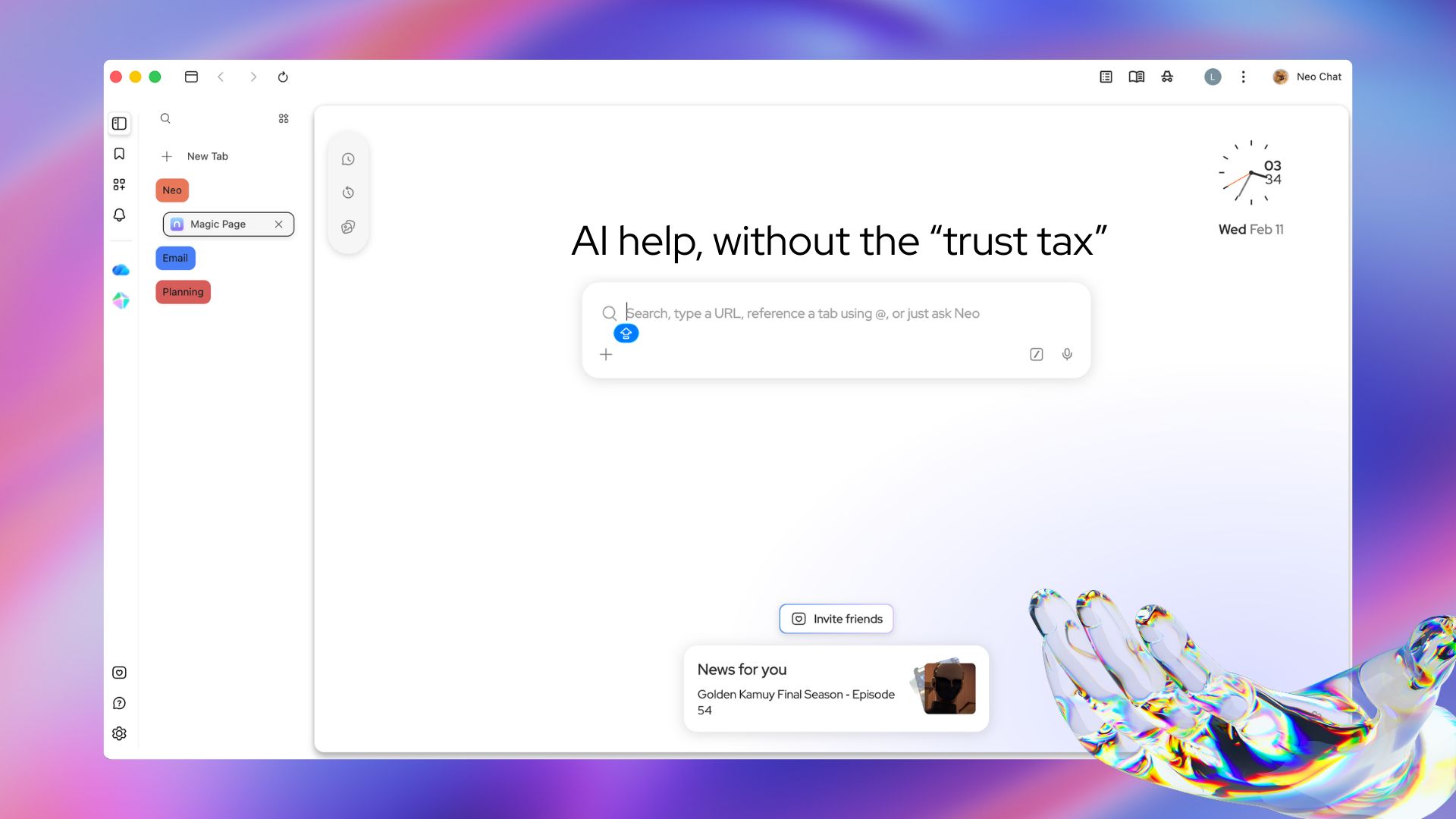
Most AI tools ask you to trade your data for intelligence. Norton Neo doesn't. It's the first safe AI-native browser built by Norton, and it gives you powerful built-in AI without handing your privacy over to get it. Search, summarize, and write with AI built directly into your browser. Your data stays yours. Your context stays private.
Built-in VPN, anti-fingerprinting, and ad blocking come standard. No add-ons. No setup. No compromises.
Fast. Safe. Intelligent. That's Neo.