- Superintelligence
- Posts
- Superintelligence Europe — No. 004
Superintelligence Europe — No. 004
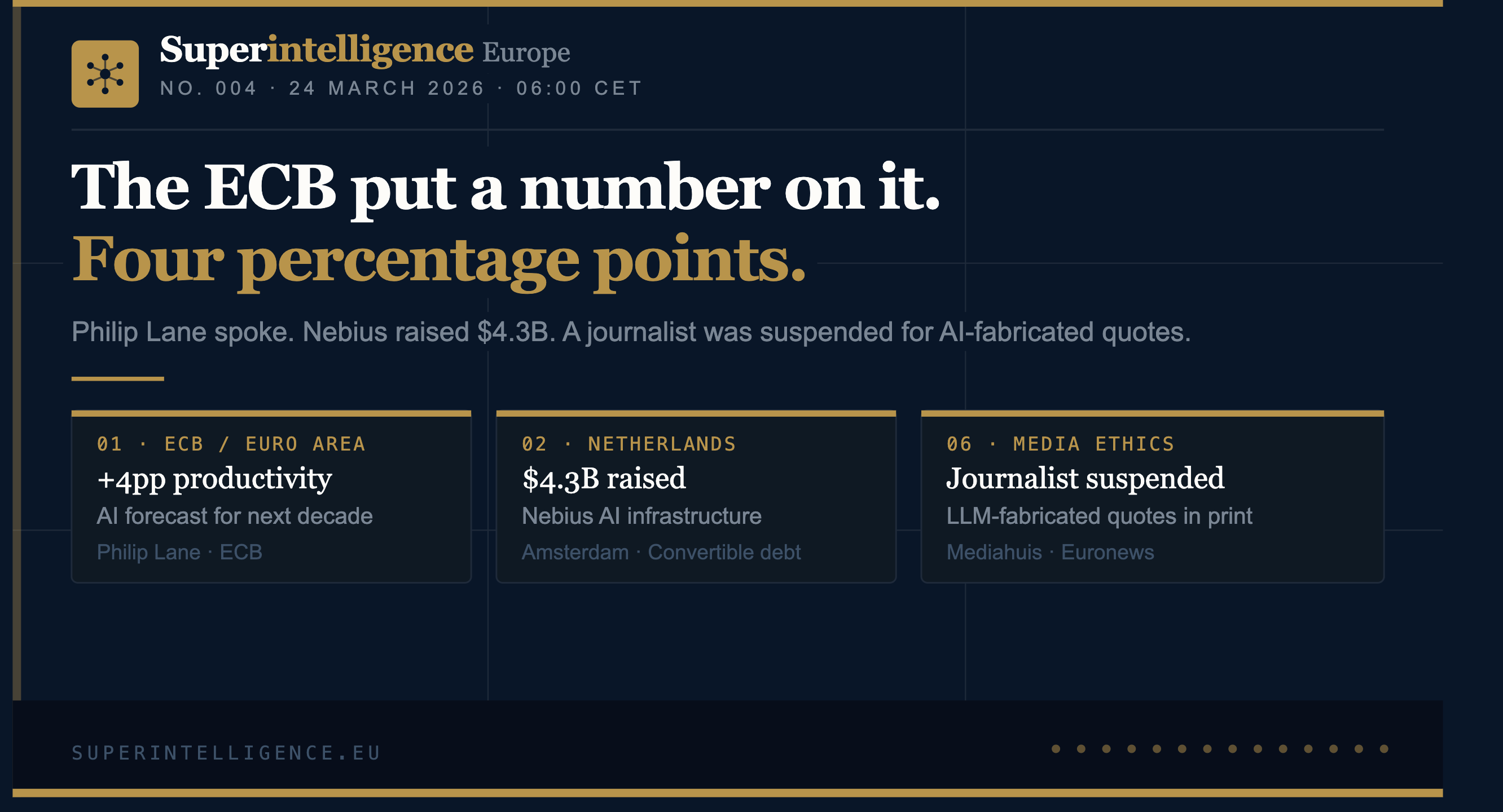
The ECB put a number on AI's value to Europe. A $4.3B infrastructure raise. A journalist suspended for AI-fabricated quotes. Your Tuesday briefing.
In partnership with

Everything that moved in European AI on Monday 23 March · Across all 27 EU member states | ||||
| ||||
Issue No. 004 — Tuesday, 24 March 2026 Monday was the kind of day that reminds you how many layers European AI actually has. The ECB put a number on what AI could mean for the euro area — four percentage points of productivity growth over a decade — and immediately complicated that figure with every structural barrier Europe still has not fixed. Meanwhile, a $4.3 billion infrastructure raise in Amsterdam and a $232 million AI-first fund closing in London showed that private capital is not waiting for the regulators to sort it out. Wired published the most detailed account yet of how AI data centres are buckling European power grids. And a senior journalist was suspended after LLM-generated quotes made it into print — a story that landed in every European newsroom. This is European AI on a full weekday: the economics, the infrastructure, the capital, and the ethics all moving at once. Eight stories. Your Tuesday morning briefing starts here. | ||||
| ||||
Lead · Euro Area · Economics / ECB 01The ECB says AI could add four percentage points to euro area productivity growth over the next decade — if Europe fixes what is holding it back Sources: ECB speech transcript · Reuters · 23 March 2026 ECB Executive Board member Philip R. Lane delivered one of the most significant economic assessments of AI’s European implications yet, projecting that accelerated AI adoption could generate total factor productivity gains of 0.3 to 0.4 percentage points per year — compounding to more than four percentage points of additional productivity growth over the coming decade. The speech positioned AI as a general-purpose technology on par with previous transformational shifts, with compounding effects across industries as adoption spreads beyond early adopters. But Lane was precise about what stands between Europe and those gains. Employee AI usage has risen to roughly 40 percent in 2025, but Europe holds just 3 percent of global AI patents against the United States’ 9 percent. Investment and deployment lag. SME access to AI tools remains uneven. Energy costs are elevated. And Europe’s bank-heavy financing ecosystem struggles to fund the intangible assets — data, models, workflows — that AI-intensive businesses depend on. Lane explicitly called for completing the EU Savings and Capital Markets Union as a structural prerequisite for closing the gap. Why It Matters The ECB does not typically wade into technology forecasting this explicitly. Lane’s speech signals that the central bank views AI adoption as a macroeconomic policy variable — not just a technology story. The patent gap and the Capital Markets Union argument are well-worn points, but attaching them to a concrete productivity number changes the political urgency. Expect this figure to be cited extensively in European competitiveness debates through the rest of 2026. | ||||
Infrastructure · Netherlands / EU-wide · Capital 02Amsterdam’s Nebius closes a $4.3 billion debt raise to build out AI data centres — with Meta and Microsoft already on board Sources: Nebius official announcement · Tech Funding News · 23 March 2026 Nebius Group, the Amsterdam-headquartered AI cloud company that emerged from Yandex’s international restructuring, announced the closing of approximately $4.34 billion in convertible debt financing — one of the largest single capital raises in European AI infrastructure to date. The proceeds are earmarked for a $16 to $20 billion 2026 capital expenditure programme covering GPU cluster build-out, data centre expansion, and cloud platform development. The raise follows major contract announcements with both Meta and Microsoft, positioning Nebius as a European-domiciled hyperscaler-adjacent platform filling demand that US-headquartered clouds cannot fully serve for European sovereignty reasons. The company’s Amsterdam base and post-Yandex Western governance structure have been central to its pitch to European enterprise and government customers. Sovereignty Angle A $4.3 billion infrastructure raise by a European-domiciled company is exactly the kind of capital formation that EU policymakers have been calling for. The fact that Nebius is supplying capacity to Meta and Microsoft — rather than competing with them at the model layer — is a pragmatic but commercially coherent bet: European infrastructure sovereignty does not require European model supremacy. | ||||
Infrastructure · Europe-wide · Energy 03The AI data centre boom is buckling Europe’s power grids — and traditional infrastructure cannot keep pace Source: Wired · 23 March 2026 Wired published a detailed infrastructure investigation on Monday documenting how the global AI race is forcing European utilities into an improvised response they were not designed to deliver. Data centre connection queues have exploded: the UK alone has more than 30 gigawatts of pending grid connection requests, against a backdrop where traditional grid build-out takes seven to fourteen years from planning to energisation. Projects are cancelling or delaying not because of a lack of capital or demand, but because they cannot get a grid connection. European utilities are innovating in response — line upgrades, demand flexibility services, dynamic connection agreements — but the pace of AI-driven demand growth is outrunning grid modernisation in almost every major market. The report also flags a geographic concentration problem: data centres are clustering in locations with existing fibre density and cooling access, creating hotspots of grid strain rather than distributing load across the continent. The Hidden Bottleneck Every European AI sovereignty strategy depends on data centre capacity. Every data centre depends on grid access. The 30GW queue figure puts a concrete number on a constraint that policy documents tend to treat as a background condition. This is the infrastructure layer beneath the infrastructure layer — and it is already limiting where AI can physically be built in Europe. | ||||
Capital · UK / Germany · Funds & Startups 04 Air Street closes $232M Fund III — now Europe’s largest solo GP AI fund UK / Europe + N. America · The Next Web · 23 Mar Nathan Benaich’s Air Street Capital announced the close of its third fund at $232 million — the largest solo general partner venture vehicle ever raised in Europe with an explicit AI-first mandate. The fund targets early-stage companies across AI in software, science, physical systems, and defence, investing across Europe and North America. Air Street publishes the State of AI Report annually — one of the most-cited AI research publications on the continent. Fund III is both a capital commitment and a signal of continued institutional LP conviction in dedicated European AI vehicles. The defence inclusion is notable given the EU’s accelerating dual-use AI agenda. 05 Munich’s Interloom raises €14.2M to build enterprise memory for AI agents Germany · EU-Startups · 23 Mar Interloom, based in Munich, closed a €14.2 million seed round led by DN Capital with participation from Bek Ventures and Air Street Capital. The company builds “context graphs” from real operational decisions — not just documents — giving AI agents access to the tacit, institutional knowledge that enterprises actually run on. The problem Interloom is solving — how to make AI agents genuinely useful in regulated enterprise environments where undocumented operational know-how is the primary asset — is one of the most commercially significant unsolved problems in applied AI. The Air Street co-investment is also notable, linking today’s fund announcement directly to its portfolio activity. | ||||
Media Ethics · Netherlands / EU-wide · Journalism 06A senior European journalist has been suspended after AI hallucinations made it into print as expert quotes Source: Euronews · 23 March 2026 Peter Vandermeersch, a senior journalist at Mediahuis — one of Europe’s largest newspaper groups — was suspended from a fellowship role after an investigation found dozens of hallucinated quotes inserted into published articles. Vandermeersch acknowledged that he had been relying on LLM-generated summaries and had not independently verified the attributed statements before publication. The case is the highest-profile instance yet of AI-fabricated content reaching publication at a major European media group, and it landed on Monday in every European newsroom actively debating where to draw the line on LLM-assisted journalism. The details matter: this was not a junior reporter cutting corners, but a senior figure at a major institution, using AI as a research summarisation tool in a way that collapsed the verification step entirely. What This Changes Every European publisher with an AI usage policy — and many without one — will be citing this case internally this week. The story is not primarily about the technology; it is about a professional accountability gap that AI makes structurally easier to fall into. Expect newsroom AI guidelines to tighten across the continent, and expect regulators to take note of how quickly reputational harm can propagate from an unremediated hallucination. | ||||
On The Ground · EU-wide · Events & Policy 07a KubeCon Europe: Cloud Native AI & Kubeflow Day runs in Amsterdam Netherlands · Linux Foundation · 23 Mar Full-day co-located event at KubeCon Europe bringing together practitioners on production-grade AI, MLOps, LLMs, Graph RAG architectures, and open-source tooling. Speakers from Red Hat, Solo.io, and Nebius participated — the latter notable given Nebius’s infrastructure raise announced the same day. Also on Monday, Tech.AD Europe 2026 opened in Berlin at Titanic Chaussee, focusing on autonomous driving AI systems — another front in applied European AI development running in parallel. 07b EU copyright law reckoning with generative AI — and Brussels holds an arms control AI session EU / Brussels · MMLC Group · 23 Mar A legal analysis published Monday documents how the European Parliament’s Legal Affairs Committee is pushing for greater AI training data transparency, cross-jurisdiction copyright compliance, and potential licensing obligations for generative AI developers — with the Brussels Effect likely to globalise whatever framework the EU lands on. Separately, UNIDIR and the EU Institute for Security Studies convened at the Justus Lipsius Building in Brussels to examine how converging AI technologies are reshaping disarmament and arms control frameworks — a dimension of AI governance that rarely surfaces in commercial coverage. | ||||
08 · Signal — Verified Voices Credible accounts and publications that drove Monday’s European AI conversation. Filtered for genuine signal. @PhilipRLane ECB Executive Board Published the most consequential European AI economics speech of the year. The four-percentage-point productivity figure was the single most-cited number in European AI policy circles on Monday. The ECB speech PDF was shared by Reuters, Bloomberg, and a dozen economics and policy accounts within hours of publication. @nathanbenaich Air Street Capital Announced Fund III on Monday. Benaich’s annual State of AI Report gives Air Street Capital unusual credibility as a signal-generator in European AI VC. The fund close was widely shared by European tech journalists, LP networks, and the AI research community simultaneously — a sign of the firm’s cross-community reach. @EUStartups European startup media First and most detailed English-language coverage of the Interloom raise, including the DN Capital / Air Street Capital co-investment angle. EU-Startups remains the most reliable daily tracker of sub-€50M European AI funding rounds — the layer of the market that other outlets systematically undercover. |
88% resolved. 22% stayed loyal. What went wrong?

That's the AI paradox hiding in your CX stack. Tickets close. Customers leave. And most teams don't see it coming because they're measuring the wrong things.
Efficiency metrics look great on paper. Handle time down. Containment rate up. But customer loyalty? That's a different story — and it's one your current dashboards probably aren't telling you.
Gladly's 2026 Customer Expectations Report surveyed thousands of real consumers to find out exactly where AI-powered service breaks trust, and what separates the platforms that drive retention from the ones that quietly erode it.
If you're architecting the CX stack, this is the data you need to build it right. Not just fast. Not just cheap. Built to last.